
Principal Investigator: Dr. Nazarij Buławka (WAUW)
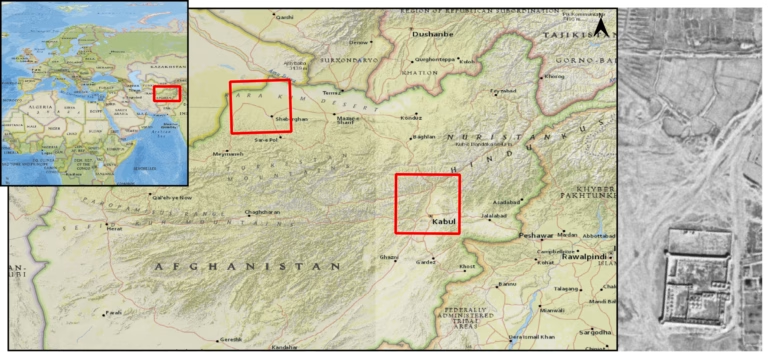
Research location: the Kabul area and the Balkh oasis in Afghanistan
Research type: research utilizing artificial intelligence and remote sensing
Chronology: all chronological phases
The AiQala project focuses on investigating the development of fortified villages, known as qala, in Afghanistan and neighboring regions.
A qala is a fortified, stand-alone village or the residence of a landowner, commonly found in Iran, Afghanistan, and neighboring countries. Settlements of this type played a key role in spatial and social organization during the Sasanian Empire (224–651 CE) and in the Islamic period. A typical qala has a rectangular layout. It is surrounded by a thick wall and protected by towers, making it easily recognizable in satellite and aerial photographs. Data on the locations of qala-type villages come from numerous ethnographic and archaeological studies. Despite extensive research, no attempts have yet been made to use artificial intelligence (deep learning) to investigate their distribution.
AiQala is a research project funded by the National Research Centers in Poland (UMO-2025/57/B/HS3/04379), aimed at elucidating the role of the qala in the development of complex societies in Afghanistan. The project involves developing deep learning models to detect fortified qala villages, the surrounding farmland patterns, and traces of water systems, including qanats (Buławka, Orengo, and Berganzo-Besga 2024).
Links
Funding
AIQala: The studies of Cultural, Socio-economic and Geographical Factors in the emergence of Fortified Settlements and its relation to irrigation systems Using Historical, Archaeological, Ethnographical Methods and Artificial Intelligence (NCN, OPUS 29, UMO-2025/57/B/HS3/04379)