
We are pleased to invite you to participate in the 7th Scientific Conference of the Faculty of Archaeology, “Przeszłość ma przyszłość!/ The Past Has a Future!”, which will take place on April 13–17, 2026, at the Faculty of Archaeology, University of Warsaw. Following the tradition of previous years, the conference has been planned as an event of both international and national scope.
Book of abstracts is available here.
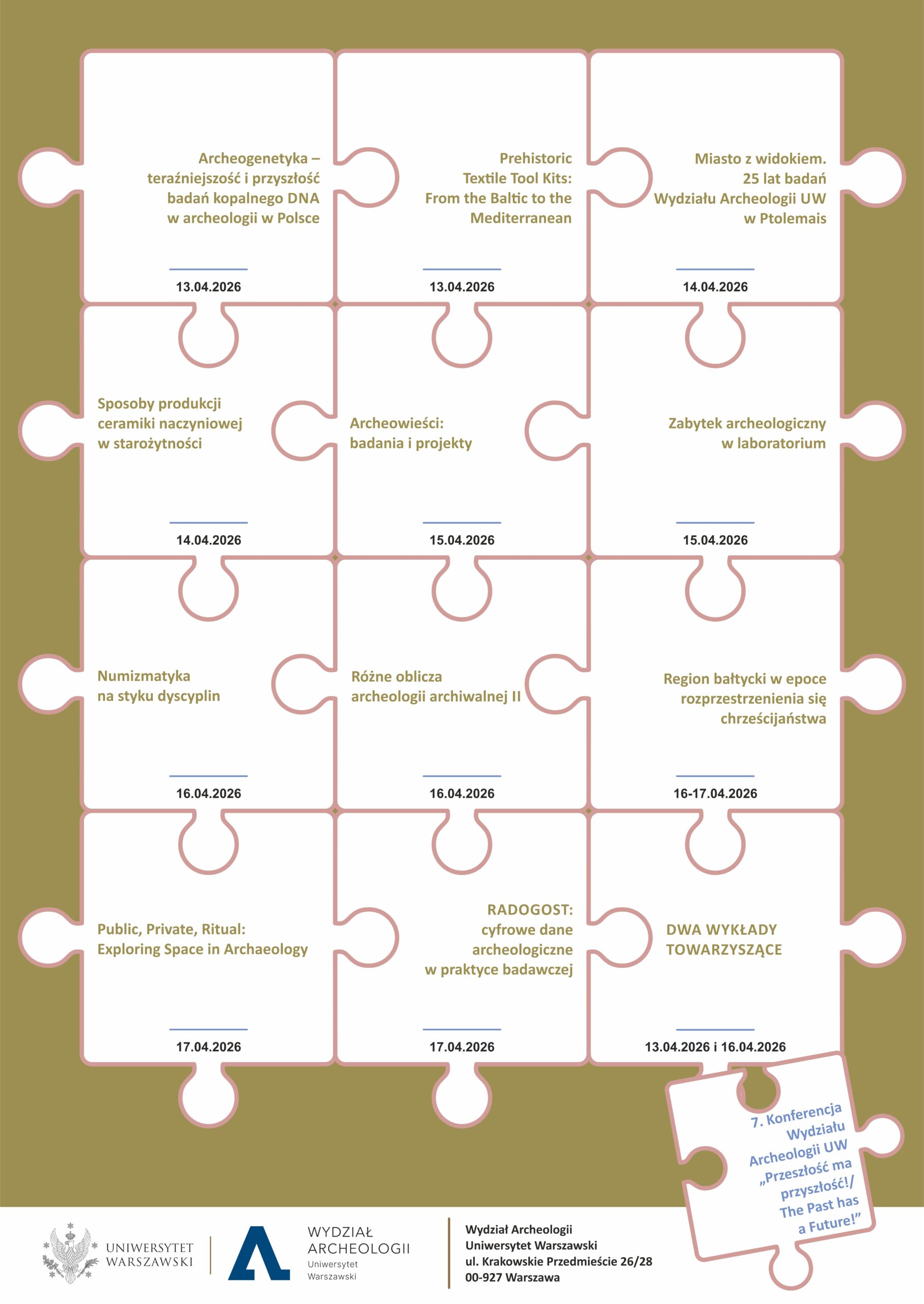
Conference poster with the session schedule
ACCOMPANYING LECTURES:
Monday, 13.04.2026, 6:30 PM
Ahmad Emrage (University of Benghazi, Libya)
Libyan Archaeological Heritage: Significance, Challenges, and Preservation Approaches
Libya’s archaeological heritage offers an extraordinary record of human civilisation, spanning tens, if not hundreds, of thousands of years of cultural development and exchange across the Mediterranean and the Saharan regions. From prehistoric sites such as Haua Fteah, one of North Africa’s most significant sequences of human occupation, to the renowned Greek and Roman cities of Cyrene and Leptis Magna, Libya offers a complex, multilayered cultural landscape of exceptional importance. These sites record early human adaptation, urban development, artistic achievement, and extensive trade networks linking Africa to the wider Mediterranean world. Collectively, they form a shared cultural legacy that strengthens national identity, advances academic research, promotes intercultural dialogue, and supports sustainable tourism opportunities.
However, Libya’s archaeological heritage remains at significant risk from both natural and human-induced threats. Natural threats include coastal erosion, desertification, climate change, and other environmental factors that accelerate deterioration, particularly in fragile archaeological contexts. Human threats, on the other hand, include looting, illicit trafficking, uncontrolled urban expansion, and inadequate site management, which further endanger these invaluable cultural resources. Political instability in recent years has further exposed sites to neglect and insufficient protection, while limited funding, inadequate infrastructure, and shortages of specialised expertise continue to constrain effective conservation efforts.
This presentation will highlight the cultural and historical significance of Libya’s archaeological heritage, examine the principal threats to it, and discuss local and international initiatives to protect it. Emphasis will be placed on documentation, capacity building and community engagement as essential components for safeguarding Libya’s rich archaeological legacy for future generations.
Czwartek 16.04.2026, godz. 18:45
Anthi Batziou (Ephorate of Antiquities of Magnesia, Hellenic Ministry of Culture, Greece), Agata Ulanowska (Faculty of Archaeology, University of Warsaw, Poland), Filip Franković (Institute for Pre- and Protohistory and Near Eastern Archaeology, Heidelberg University, Germany), Peter Pavúk (Institute of Classical Archaeology, Charles University in Prague, Czech Republic), Dimitris Agnousiotis (Ephorate of Antiquities of Magnesia, Hellenic Ministry of Culture, Greece), Iacovos Georgiou (Ephorate of Antiquities of Magnesia, Hellenic Ministry of Culture, Greece)
Gates of the Wind: Connectivity and Interaction in the North Aegean from the Perspective of a New Research Project on Skopelos, Northern Sporades
The Bronze Age Eastern Mediterranean is characterised by increase in social complexity and urbanisation level, state formation processes and the intensification of interregional interaction, accompanied by the movement of objects, practices, and people. Although often regarded as peripheral to region-wide development, the Aegean played a significant role in the creation of interaction networks linking the Near East, Cyprus, Anatolia, and Egypt. Aegean islands formed critical nodes within these networks, shaping various interpretative frameworks centred on conquest, migration, colonisation, and acculturation within and beyond the borders of the region.
Among the Aegean islands, the Northern Sporades occupy an exceptionally favourable position for maritime communication within the Aegean and beyond, owing to the configuration of the archipelago and well-documented wind and sea-current patterns. Surprisingly, however, the Northern Sporades remain one of the least systematically investigated regions of the Bronze Age Aegean, despite the archaeological evidence pointing to their significance for the formation of regional interaction networks in both earlier and later periods.
The Ancient Skopelos Survey project (ASkoS, 2024–2028) addresses this gap by examining the role of the Northern Sporades during the third and second millennia BCE, with particular focus on Skopelos, the largest yet still insufficiently explored island of the archipelago. The project is a collaborative endeavour (synergasia) with the Ephorate of Antiquities of Magnesia of the Hellenic Ministry of Culture and is conducted under the auspices of the Polish Archaeological Institute at Athens, in collaboration with the Universities of Warsaw, Heidelberg, and Charles University in Prague.
This keynote presents the project’s objectives and first results, situating Skopelos within wider Aegean and Eastern Mediterranean interaction networks and assessing its potential contribution to current debates on connectivity, mobility, and local agency in the Bronze Age.
 Organisers: Renata Ciołek, Anna Zapolska (Faculty of Archaeology University of Warsaw)
Session format: in-person
Session language: Polish
For more information see => Numizmatyka na styku dyscyplin – Wydział Archeologii UW
 Organisers: Mikołaj Pławiński, Ludwika Jończyk, (Faculty of Archaeology University of Warsaw), Rytis Jonaitis, Irma Kaplūnaitė (Lithuanian Institute of History)
Session format: in-person
Session language: Polish/English
The spread of Christianity in various parts of the vast Baltic region was a long process that lasted for more than half a millennium and gradually transformed all aspects of human life as well as the perception of death and eschatological concepts, and consequently, also the funerary rituals.
The session will focus on discussing the changes – or their absence – in different aspects of daily life, material culture, and burial practices, in all their diversity. The aim of the session is to describe and explain the mechanisms of transformation brought about by the spread of Christianity in different parts of the Baltic region during the last centuries of the first and the early centuries of the second millennium AD.
 Organisers: Anna Juga-Szymańska, Paweł Szymański (Faculty of Archaeology University of Warsaw)
Session format: in-person
Session language: Polish
For more information see => Różne oblicza archeologii archiwalnej II – Wydział Archeologii UW
 Organiser: Dariusz Błaszczyk (Faculty of Archaeology University of Warsaw)
Session format: in-person
Session language: Polish
For more information see => Archeogenetyka – teraźniejszość i przyszłość badań kopalnego DNA w archeologii w Polsce – Wydział Archeologii UW
 Organisers: Julia Chyla, Arkadiusz Sołtysiak, Michał Starski (Faculty of Archaeology University of Warsaw)
Session format: in-person
Session language: Polish
For more information see => RADOGOST: cyfrowe dane archeologiczne w praktyce badawczej – Wydział Archeologii UW
 Organisers: Agata Ulanowska, Monika Kaczmarek, Kinga Winnicka, Katarzyna Żebrowska (Faculty of Archaeology, University of Warsaw), Magdalena Przymorska-Sztuczka (Archaeological Museum in Biskupin), Gerasimoula Ioanna Nikolovieni (Joukowsky Institute for Archaeology and the Ancient World, Brown University)
Session format: in-person
Session language: English
Textile tools, specifically clay spindle whorls and loom weights, frequently comprise the basic, albeit indirect, evidence for textile production in past societies. Over the last 20 years, notable progress in textile tools studies has made them not only informative about the qualities of textiles produced using them, but also brought them into the mainstream of archaeological artefacts, which has led to their publication in more comprehensive and comparative ways. However, both spindle whorls and loom weights are only parts of more complex implements and sets, such as spindles and distaffs, and always many tools were required to produce a textile. Textile tools kits included a series of different instruments, either personal or communal, including, e.g. spinning bowls, dyeing implements, carders, combs, metal scissors, metal and bone needles designed for different purposes, pins, hooks, shuttles, weft beaters, so called pin-beaters, various loom-types, and many more, several of which served multifunctional roles. But textile tools kits are found only occasionally, and since tools were frequently dispersed, they are often published separately according to the material from which they were made, while some may still await proper recognition. In this session, we would like to focus on textile tool kits by asking questions about their contexts – domestic, ritual, funerary; their specific functions and purposes, and use-wear; the particular sets of tools that might constitute a kit; their materiality, including a broad range of materials and tool making techniques, and, finally, possible biographies of textile tool kits that made them such unique finds.
The session program is available here.
ABSTRACTS (alphabetically by author):
Miriam de Diego (L’Escola d’Art i Superior de Disseny Llotja, ESDAPC Higher School of Design and Visual Arts of Catalonia, Spain), Raquel Piqué (Autonomous University of Barcelona, Spain), Antoni Palomo (Autonomous University of Barcelona, Spain), Xavier Terradas (IMF-CSIC, Spain), Ignacio Clemente (IMF-CSIC, Spain)
Tools related to textile production at the Early Neolithic site of La Draga (Spain) (5300-4700 aC)
The early Neolithic waterlogged site of la Draga (Spain) (5300-4900 cal aC.) has yielded a diverse set of tools potentially related to textile production. Although no textile fragments have been preserved, the site provides evidence for knowledge of activities related to the acquisition and processing of fibers, as well as remains of rope fragments and basketry. Among the wooden tools linked to textile production related tasks are combs, spindles, and/or shuttles made of boxwood (Buxus sempervirens). All these instruments are similar to those used by modern and ancient communities during the spinning and weaving processes.
In adition to the wooden tools, the site has provided several bone tools, including eyed needles, awls, bone spindle whorls (for which there is ethnographic evidence) and possible tensioners and rope making devices, all of which may have played a role in textile production. In this presentation, the previously studied wood and bone instruments will be presented, with a particular focus on the results of the use-wear analyses to determine their potential role in textile processes.
Patrycja Godlewska (Institute of Archaeology, Nicolaus Copernicus University in Toruń, Poland)
Connections between Spinning, Weaving, and Aquatic Environments Based on Archaeological and Ethnographic Evidence: Symbolism or Pragmatism?
The use of water in flax processing appears primarily pragmatic, resulting from the compact structure of the fibres – water softened the raw material and facilitated subsequent stages of work. However, relationships between flax and aquatic environments may also be interpreted beyond utilitarian frameworks, particularly in the context of textile production practices. Based on data from prehistoric and early medieval archaeological sites in East-Central Europe, contexts can be identified in which textile tools and their assemblages were deposited in lakes, littoral zones, and wells, suggesting intentional practices. The dispersion of finds and their specific locations points toward non-utilitarian meanings behind these deposits.
Ethnographic sources from Western and Eastern Slavic regions document symbolic and occasionally magical associations between water and spinning and weaving. These are personified by the East Slavic figure of Mokosz, as well as by aquatic demons engaged in textile work within bathhouse spaces. The motif of the symbolic “loss” of needles and spindle whorls in wells was noted by Władimir Propp. The mill likewise functioned as a liminal space connecting water and land; its wheel moved in rotational motion analogous to that of the spindle whorl on the spindle. This paper presents selected archaeological examples of the deposition of textile tools and tool assemblages in aquatic environments and, in comparison with ethnographic data, proposes an interpretation of their functions, contexts, and “biographies”. It argues for understanding these practices within a broader symbolic framework linking water with spinning, weaving, and textile production.
Francisco B. Gomes (School of Arts and Humanities of the University of Lisbon, UNIARQ – Centre for Archaeology of the University of Lisbon, Portugal), Catarina Costeira (Integrated Researcher – Centre for Archaeology of the University of Lisbon, Portugal)
The Many and the Few: Making Sense of Pre- and Protohistoric Textile Tool Kits in Southern Iberia (2nd and 1st millennia BCE)
In recent years, our understanding of textile production during the Bronze and Iron Ages of Southern Iberia (roughly the 2nd and 1st millennia BCE) has progressed significantly. At the basis of this progress is the integrated study of textile tools, and their assessment as part of broader textile chaîne opératoires.
However, throughout these periods there are numerous incongruences in the available documentation which pose interpretive challenges and require careful reconceptualization. This presentation will start from the concept of what the basic “textile tool kit” should have been in this area throughout this period considering what we know of regional textile technologies at the time and discuss the significance of deviations from that expected “standard”.
These deviations can correspond to the lack of specific expected tools – as, for example, spindle whorls in Bronze Age contexts of Southwestern Iberia – or an imbalance between the number of tools – as in the overrepresentation of spindle whorls over loom weights throughout the Iron Age. In this contribution, we will explore the significance of these absences/ imbalances beyond the conventional explanations based on the use of tools in perishable materials.
On the opposite side of the spectrum, these deviations can feature the inclusion of rare and uncommon tools detected in some Iron Age contexts, such as spools, weaving tablets, potentially distaffs, as well as shears and combs. Here we will consider the social and cultural significance of these “rare” tools, and their overall impact in the overall textile technologies and economies of this period.
Monika Kaczmarek (Faculty of Archaeology, University of Warsaw, Poland)
Late Neolithic Textile Tool Kits from the Western Polish Lowlands: Problems of Identification and Interpretation
Textile tools such as spindle whorls, loom weights, and spools are rare finds at Neolithic sites in the western part of the Polish Lowlands. Most are single clay artefacts, and there is no evidence that textile tools were deposited in graves. Consequently, complete sets of textile tools have not been identified at the majority of sites. Rather than treating this absence as a straightforward reflection of past practices, this paper approaches it as a problem of archaeological visibility and interpretation.
The paper examines how the material record of Late Neolithic (ca. 3000–2200 BCE) textile production is constituted, classified, and interpreted. Drawing on data from selected sites, it interrogates the low frequency of textile tools not simply as an empirical fact but as a state of artifact preservation, research traditions, and analytical frameworks. Is the limited number of identified tools the result of the use of perishable materials, or does it point to regionally specific modes of fibre processing and textile production? To what extent do ethnographic analogies structure archaeological reasoning and shape what is recognised as evidence of textile-related activity? Furthermore, how does the dominant practice of analysing artefacts primarily according to raw material limit the identification of function and technological context?
By reframing the issue from one of absence to one of interpretative practice, the paper proposes a methodological approach that foregrounds contextual analysis, chaîne opératoire perspectives, and the integration of indirect evidence. In doing so, it seeks to contribute to broader discussions on craft production, materiality, and the limits of inference in textile archaeology.
Julia Fileš Kramberger (Department of Archaeology, Faculty of Humanities and Social Sciences, University of Zagreb, Croatia), Karina Grömer (Natural History Museum, Vienna, Austria)
Greetings from the Eastern Hallstatt area – common and strange textile tools in use
Textile tools such as spindle whorls and loom-weights are ubiquitous objects in Early Iron Age settlement contexts and are direct evidence of textile manufacture on a given site. Nevertheless, groups of such objects in settlements imply either specialised workshops or places dedicated to textile production within a household. On the other hand, combinations of textile related finds in graves might indicate specialized “kits”, which might have belonged to the deceased (women), and were their personal tool-sets used during life or served as markers of their layered and interconnected identity and textile craftsmanship.
Diverse combinations of such tools and tool-sets are known throughout the Eastern Hallstatt area, so this paper will present recent findings of textile tool sets from Central Europe (Austria, Hungary and Croatia). Especially interesting are such sets and in-situ textile tools found in closed contexts within settlements in relation to burial contexts within the same sites, which offers the opportunity of researching the functional and symbolic dimension of potential sumptuous grave goods. Additionally, some new insights on T-shaped tools resembling pintaderas, found throughout the mentioned area, might open up new questions and speculations related to the textile chaîne opératoire in European prehistory.
Finally, this perspective and research area will further be broadened to finds from North-Eastern Balkans, showing examples of textile production tool kits from mostly elite, female burial contexts outside the borders of the Hallstatt world.
Giulia Muti (Institute of Archaeological Sciences, University of Bern, Switzerland)
Counting whorls, counting hands? Reframing spindle whorl assemblages in Bronze Age Cyprus
Spindle whorls are ubiquitous finds at Bronze Age (BA) sites in Cyprus. They vary in size, shape, material, and often display rich decoration. These artefacts appear in diverse contexts, from domestic spaces to productive areas and burials, frequently occurring in concentrations. Clustering has been interpreted as evidence for spinning ‘sets’ or ‘kits’, defined through spatial grouping, functional homogeneity or variability, or formal similarities such as shared decorative schemes. Larger whorl concentrations have also been linked to increased thread production and to the emergence of “super-household” organisation. However, the definition of a set remains variable in the literature and often overlooks the human dimension of spinning, including the time required to produce sufficient thread for weaving, and the intermittent and portable nature of the activity. Additionally, the intensification in whorl occurrence and clustering corresponds to another broader trend: the general increase in their size during the late Early and Middle BA. Whether these changes are functional, dependent on manufacture, or reflect broader socio-economic choices remains open.
This paper addresses these issues through a longue durée analysis of Cypriot spindle whorls, from their first appearance on the island to the Late BA, when average size declines again. Patterns of clustering will be interpreted by examining contextual associations and functional differences across a large sample. Attention is also given to their relationships with other textile tools, evaluating whether these associations indicate coherent tool sets for specific textile activities. Ultimately, this study uses spindle whorls to reflect on concentrations of textile tools and contribute to broader methodological discussions in textile archaeology regarding productive landscapes and their organisation.
Magdalena Przymorska-Sztuczka (Archaeological Museum in Biskupin, Poland)
Textile Toolkits in Funerary Contexts of the Wielbark Culture
This paper examines textile toolkits from Wielbark culture graves dating from the 1st to 4th centuries AD. Although these tools are usually associated with settlement and domestic work, items like spindle whorls, distaffs, needles, and shears also appear in burials. Their deposition raises questions regarding gender, identity, and symbolic practices.
Using excavation reports from selected cemeteries in present-day northern Poland, this study analyses the typology, material composition, spatial placement, and frequency of textile implements in both inhumation and cremation burials. Special attention is given to their association with other grave goods, such as dress accessories, personal ornaments, and imported Roman items. The analysis assesses whether textile tools primarily served as indicators of gender roles, markers of social status, or symbolic references to household production and continuity. The Wielbark funerary rite is characterised by a general avoidance of weapon deposits, in contrast to contemporary Przeworsk traditions. In this context, textile equipment may have played a distinctive role in expressing identity, particularly in female burials. However, examples from ambiguous or richly furnished graves complicate a strictly gendered interpretation.
By situating textile toolkits within broader discussions of craft production, embodiment, and mortuary display, this paper contends that these artefacts functioned not only as reflections of everyday labour but also as meaningful symbols embedded in the social and cosmological order of Wielbark communities.
Agata Ulanowska (Faculty of Archaeology, University of Warsaw, Poland)
Beyond the Functionality: Minoan Textile Tools from the Site of Sissi on Crete, or How to Approach Dispersed, Varied, yet Numerous Evidence
Spindle whorls, loom weights, and spools from Bronze Age Greece have been the focus of intensive research for more than two decades, both at site-specific and regional, culture-specific levels. These tools constitute the most frequently preserved evidence for textile production in the Aegean contexts, but they always served as parts of more complex implements, such as spindles and looms, which in turn were elements of even more complex tool kits. However, spindle whorls, loom weights and spools themselves provide important insights into production, and specifically into its organisation and scale, as well as the quality of the final products, such as threads and woven textiles.
In this paper, I would like to discuss the assemblage of spindle whorls, loom weights, and spools from the important Minoan site of Sissi on Crete, which I have been studying since 2021, continuing the research of the late Joanne Cutler. This assemblage comprises c. 700 implements in total, with new tools being unearthed through the ongoing excavations, of which 429 tools have been so far examined. The aim of this paper is to present methodological concerns regarding how to approach such evidence – clearly abundant, yet incomplete – with many dispersed, single tools from fill contexts, and only a few potential loom sets, but never entire tool kits. It also addresses the meaning of use-wear marks, as well as the challenge of creating functional typologies, resulting from a Sissi-specific preference for functionally different forms belonging to one general type.
Selena Vitezović, Ivan Vranić (Institute of Archaeology, Belgrade, Serbia)
Textile tools from the Late Iron Age site of Kale – Krševica (southern Serbia)
The site of Kale – Krševica is situated in southern Serbia in vicinity of the modern town of Vranje, with archaeological remains dating from the late 5th till the first half of the 3rd century BCE. Kale – Krševica was a specific settlement site, with peculiar material remains, including portable findings with Greek-like characteristics and structures built in accordance with Late Classical and Early Hellenistic period Greek architectural technology. The site yielded rich and diverse portable finds, that suggest strong trade and exchange with neighbouring regions, as well as significant production of craft goods from diverse raw materials, including perishable materials. One of the particularly important craft activities was textile production. Although the traces of textile were not recovered, diverse tools from clay, bone and metal were found, used in different stages of textile production. These items were usually analysed separately, along with other finds from the same material, and here we will attempt to present the entire tool kit for textile production. We will also discuss the overall organisation and importance of textile production at Krševica, as well as the questions regarding local traditions and Aegean influences.
Kinga Winnicka (Faculty of Archaeology, University of Warsaw, Poland)
Missing tools – missing textiles? The case of the Mierzanowice culture (Early Bronze Age)
An examination of the material culture of the epi-Corded Ware (ECW) horizon, to which the Mierzanowice culture belongs, shows that there are no explicit traces of textile production: no workshops, no specialised tools, no loom weights, and only a handful of possible spindle whorls across the horizon. What we do have are decorative cord impressions on pottery from funerary contexts, which demonstrate the production of cordage – either by spinning or by splicing fibres to create thread, and subsequently plying those threads into cords. If spinning tools or tool kits (such as spindles, spindle whorls, and distaffs) were used, they must have been made from perishable materials and therefore did not survive archaeologically.
What is also present in funerary assemblages are worked bone objects. Mierzanowice culture bone inventories are dominated by ornaments and pointed implements – I argue that the latter may represent the only surviving textile tools of the entire horizon. ECW communities had limited craft specialisation, and cross-crafting was likely – plant-fibre work (continuing earlier bast-fibre traditions) and hide- or leather-working could have been carried out with the same pointed implements, resulting in multifunctional tool kits deposited in graves. In this context, any textile interpretation must be grounded in use-wear rather than typology alone. The pointed objects analysed here exhibit characteristic use-wear patterns (tip rounding, striations and polish) consistent with repeated contact with soft materials and actions such as piercing, pushing, separating threads, and tensioning. These traces offer the most compelling evidence for otherwise invisible textile practices.
 Organisers: Marta Kaczanowicz, Anna Wodzińska, Dobrochna Zielińska (Faculty of Archaeology, University of Warsaw)
Session format: in-person
Session language: English
Our aim is to encourage reflection on the changing concept of space in archaeology – how it is defined, experienced, and represented in material sources; how categories such as “public” and “private” have developed in different cultural and historical contexts; and how the boundaries between them are shaped through social practices. We welcome both regional and comparative approaches, encompassing various periods and research traditions. Topics may include, but are not limited to: changing perceptions of space over time, gendered and geographical differences, ritual aspects, and other perspectives that broaden the understanding of this multifaceted phenomenon. We hope this session will become a meeting ground for diverse research traditions and theoretical perspectives, as well as a forum for sharing concrete research results (case studies) that help us understand how space was (and continues to be) created through everyday, ritual, and symbolic practices.
The session program is available here.
ABSTRACTS (alphabetically by author):
Miłosz Giersz (Faculty of Archaeology, University of Warsaw, Poland, Castillo de Huarmey Archaeological Project), Roberto Pimentel Nita (Doctoral School of Humanities, University of Warsaw, Poland; Castillo de Huarmey Archaeological Project)
Built to Exclude, Made to Gather: Mortuary Architecture, Ancestors, and Sacred Space at Castillo de Huarmey (Peru)
How “private” is a tomb – and when does funerary architecture become a space of collective experience? This presentation addresses these questions through mortuary contexts excavated at Castillo de Huarmey on the Peruvian north coast (Middle Horizon Period, c. 9th–11th centuries CE). Although some burial spaces are architecturally enclosed and appear designed to restrict access, the archaeological record suggests that mortuary places at the site were not socially sealed or limited to a single interment episode. Evidence for reopening, staged deposition, offerings, and continued maintenance points to repeated engagements through which the dead operated as ancestors and the boundaries between inside/outside and exclusive/shared were continually negotiated. Assemblages associated with these contexts are strikingly heterogeneous – ceramics, textiles, and metal objects, produced in multiple artistic styles and technological traditions – Indicate participation across broader social and cultural networks rather than simply the display of wealth. By treating “public,” “private,” and “ritual” as outcomes of practice (access control, recurrent visitation, and materialized remembrance) rather than fixed spatial types, the presentation argues that mortuary monumentality at Castillo de Huarmey helped produce a sacred landscape in which memory, belonging, and authority were actively made and remade over time.
Karel Innemée (Faculty of Archaeology, University of Warsaw, Poland)
Worship, Devotion, and Sacred Space
Churches, like temples, are the locations where a human being gets in contact with the sacred. This contact can be achieved through the intervention of a priest, a person that has the responsibility of performing sacraments, but the believer can also get into contact with the realm of the divine directly. The interior of a church is structured in such a way that that specific spaces are reserved for specific kinds of communication with the divine, this in contrast to temples, that were less or not at all accessible to lay people. This presentation offers an overview of how the structuring of sacred space in church buildings developed over time.
Marta Kaczanowicz (Faculty of Archaeology, University of Warsaw, Poland)
Mapping Gendered Presence in Ancient Egyptian Mortuary Spaces
It may come as a surprise that, despite extensive scholarship on ancient Egyptian mortuary space, the actual spatial arrangement of burials within tombs has received remarkably little attention. This oversight reflects a long-standing Egyptological interest in iconographic programmes, with archaeological context relegated to secondary position in scholarship. As a result, the predominantly male-centred decoration of most known monuments has been taken to represent the structure of mortuary practice itself, producing a model of ancient Egyptian mortuary culture as overwhelmingly male-dominated, with women as absent or marginal actors.
However, analysis of burial data demonstrates that this imbalance is not necessarily reflected in the archaeological record. When examined through the distribution and arrangement of interments, tomb space emerges as more complex and less exclusively male than the normative image conveyed by ancient Egyptian formal art suggests. By shifting attention from representation to practice, this study calls for a reassessment of how gender is reconstructed in ancient Egyptian mortuary contexts.
Martin Lemke (Faculty of Archaeology, University of Warsaw, Poland)
Blurred Lines. Protected Space and the Military-Civilian Conflation in the Context of a Newly Discovered Late Roman Fortification in Dobruja (Romania)
The hitherto unknown Late Roman hillfort or fortified town built on the slopes of the isolated Dealul Consul (Consul Hill) in the Taiţa River valley, which crosses Dobruja on a northwest-southeast axis, was recently surveyed twice and investigated with geophysical prospection. As a result, it was possible to determine the course of the defensive walls and select areas for future investigations. Given the slope the living conditions were somewhat inconvenient, but in the times of a Barbarian raid across northern Dobruja certainly more secure than in the village at the river.
In a broader interpretation, the new site adds to a proposed a chain of “inner fortifications” in Scythia, reaching up into the Dobruja from the south along a central axis, more or less in equal distance to the Danube in the West and the Black Sea in the East. This chain is created when the bellum scythicum and later conflicts force the Roman command of Moesia inferior/Scythia to regroup and the civilians in the area to improvise, leading to a cooperation born out of necessity, which in turn distorts the once sharp division between military and civilian space on the frontier.
Grzegorz Ochała (Faculty of Archaeology, University of Warsaw, Poland)
Archaeological Spaces as Lieux de Mémoire: A Case Study from Christian Nubia
In interpreting spaces in archaeology, it is interesting to look not only at practical aspects of activities carried out in them (ritual services performed in holy places, crafting goods in workshops, collecting documents in archives, etc.), but also their potential role in forging and preserving social cohesion of smaller and larger communities. One way to approach this issue is through memory studies, which investigates different forms of commemorating past events and individuals, in order to understand the present, but also to shed light on possibilities of future developments. This is not always apparent in archaeological material and certainly cannot be accessed through detailed studies of individual features. Only through a holistic attitude, in which insights from archaeology, architecture, material culture, art, and written sources are combined, are we able to answer the questions on how memory was cultivated and perpetuated in a given community and what significance it had on its members. In my paper, I will present several case studies, including Faras cathedral, the so-called Anchorite’s grotto in Faras, and the Upper Church at Banganarti, and attempt to show on their basis the potential functioning of these and similar spaces as Nubian lieux de mémoire, in which different types of memory combined to form a true memorial landscape.
Grzegorz Ochała, Dobrochna Zielińska (Faculty of Archaeology, University of Warsaw, Poland)
Holy Hosts. On the Visual and Written Manifestation of the Dedication of Churches in Nubia
The church is a space with multiple functions. It serves as a place for the faithful to gather during liturgy and private worship, as well as a place to display the concepts of ecclesiastical and secular authority. However, a church as a place dedicated to a specific saint is also a space that this saint hosts. How was the presence of the ‘holy hosts’ of these sacred places marked? In what context do their images and names appear? Can this manifestation bring something new to the understanding of the interior space of the church, but also to the cult of saints in Christian Nubia?
Anna Smogorzewska (Faculty of Archaeology, University of Warsaw, Poland)
Ritual Closing and Feasting in Domestic Space: A Perspective from the Near East
Archaeological evidence from the Ancient Near East shows that closing of houses was often structured ritual rather than a simple abandonment. These practices involved cleaning, burning or depositing special items. Commensality or feasting also played a significant role in the social life of past societies. This papers explores these practices based on the Near Eastern examples with a special reference to Tell Arbid, a site in north-eastern Syria, where evidence of ritual closing and commensality were identified in domestic context.
Anna Wodzińska (Faculty of Archaeology, University of Warsaw, Poland)
Ancient Egyptian Potter’s Workshop – Space and Function
This paper examines the organization of work and space in the ancient Egyptian potter’s workshop, focusing on functional layout and optimal spatial arrangement as reconstructed from archaeological and pictorial evidence. By integrating material remains with iconographic sources and comparative data from modern workshops, the study aims to reconstruct patterns of production, labor division, and spatial logic across different periods of Egyptian history.
Archaeological evidence provides the structural framework for this reconstruction. Data from Predynastic Hierakonpolis reveal early installations associated with ceramic production, offering insight into spatial clustering of kilns, working areas, and clay preparation zones. Old Kingdom evidence from Abusir and the late Old Kingdom settlement at Ain Asil demonstrate increasingly standardized production spaces, often integrated into settlement planning. New Kingdom material from Amarna illustrates large-scale ceramic manufacture connected to urban supply systems. Additional evidence from Medamud, spanning the New Kingdom to the Ptolemaic Period, documents long-term continuity and adaptation in workshop organization.
Iconographic sources from tombs of the Old, Middle, and New Kingdoms complement the archaeological record by depicting sequences of production, division of labour, and workshop interiors. These representations clarify relationships between potters, assistants, tools, and firing installations, as well as the spatial proximity required between stages such as clay preparation, forming, drying, and firing.
Comparative reference to modern traditional workshops in Disuq, Fustat, Nazlet el-Nazla, Taramsa, and el-Qasr provides ethnographic parallels for understanding practical constraints, ergonomic considerations, and optimal spacing within productive environments. These living traditions illuminate how workflow efficiency, fuel management, ventilation, and social organization shape the internal logic of workshop space.
By synthesizing archaeological, iconographic, and ethnographic evidence, the paper proposes a model of the ancient Egyptian potter’s workshop as a dynamic and adaptive production unit, structured by technological requirements, environmental conditions, and social organization.
Janusz Wołoszyn (Faculty of Archaeology, University of Warsaw, Poland)
How Were Ritual Spaces Created at Toro Muerto (Peru), a Monumental Ceremonial Rock-art Centre?
Toro Muerto is one of the largest rock-art sites in South America, located in southern Peru (Arequipa region). Its beginnings can likely be linked to around the turn of the era, but the site was probably used by several different cultural groups until Inka times. At the scale of the landscape, it is clear that Toro Muerto was a powerful and important ceremonial centre (without built architecture): some areas were suited to “public” activities—large gatherings and events that were not only creative in nature but also involved offerings—while others likely had a more “private” character. In addition to petroglyphs, the complex also includes geoglyphs, routes/tracks, and cemeteries.
This paper focuses on Sector X, a part of Toro Muerto first documented in 2017 and studied more intensively since 2022. Based on our current results, this part of the complex may have functioned as an astronomical observatory. We ask not only what was done there, but how this place was constructed and how it could have worked in practice. We discuss: (1) the distribution and orientation of decorated panels, (2) the control of visibility and movement on the ground (where the observer(s) stood and what was visible), and (3) possible human interventions affecting the position of selected boulders.
Anna Zapolska (Faculty of Archaeology, University of Warsaw, Poland)
Designing Power in a Former Borderland: Elite Hoards and the Reconfiguration of Space in the Vistula–Pasłęka Region in Migration Period
During the early Migration Period, the lower Vistula–Pasłęka region underwent a marked spatial transformation. The earlier Wielbark settlement network became diluted, producing a landscape of reduced density. Into this restructured environment moved elites connected with the Cherniakhiv cultural sphere from the south, while West Balts’ groups expanded from the Sambian Peninsula. Both became established within a territory that had previously functioned as a cultural borderland: in the Roman Period, the Pasłęka River marked the boundary between Baltic and Germanic communities – in the Migration Period, this division dissolved.
Within this newly negotiated contact zone, at least two elite gold deposits were placed in close proximity to the shared cemetery at Młoteczno and along the Pasłęka communication corridor. One of them (Trąbki) may originally have been deposited on a river island, suggesting deliberate spatial visibility rather than concealment.
This paper argues that these hoards functioned as public markers of authority. Their composition – including prestigious Roman medallions and carefully curated older coins – indicates that elite legitimacy relied on portable symbols of memory and imperial connection. The absence of early Germanic female elite burials in the region suggests that the initial phase of migration may have involved predominantly male warbands.
In a fluid post-migratory landscape, gold deposits materialised claims to power, transforming a former boundary into a structured and symbolically controlled space.
 Organisers: Paweł Szymański (Faculty of Archaeology, University of Warsaw), Agata Wiśniewska (The Stefan Woyda Museum of Ancient Mazovian Metallurgy in Pruszków)
Session format: in-person
Session language: Polish
For more information see => Sposoby produkcji ceramiki naczyniowej w starożytności i we wczesnym średniowieczu na terenach dzisiejszej Polski – Wydział Archeologii UW
 Organiser: Piotr Jaworski (Faculty of Archaeology University of Warsaw)
Session format: in-person
Session language: Polish
For more information see => Miasto z widokiem. 25 lat badań Wydziału Archeologii UW w Ptolemais – Wydział Archeologii UW
 Organisers: Katarzyna Pyżewicz, Marcin Wagner (Faculty of Archaeology University of Warsaw), Barbara Wagner (Biological and Chemical Research Centre University of Warsaw, Faculty of Chemistry University of Warsaw)
Session format: in-person
Session language: Polish
For more information see => Zabytek archeologiczny w laboratorium – Wydział Archeologii UW
 Organisers: Dariusz Błaszczyk, Marta Kaczanowicz, Marcin Wagner (Faculty of Archaeology University of Warsaw)
Session format: stacjonarna/in-person
Session language: Polish/English
The presentations in this session will focus on key research problems formulated by scholars in the course of their archaeological investigations. The talks will also serve as an attempt to synthesize and summarize the scientific and research activities of the staff of our Faculty, carried out both individually and within research teams—often formed in collaboration with researchers from various institutions. The session will additionally highlight the role and significance of different disciplines supporting archaeology.
 This year’s edition will focus on Polish archaeological research not only in Egypt and Sudan, but also in Ethiopia and Tanzania.