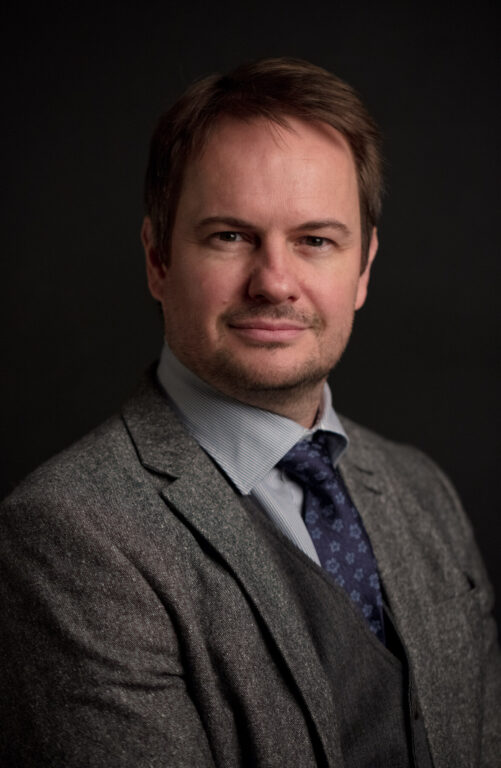
Mueller-Bieniek Aldona

Aldona Mueller-Bieniek
dr hab. Aldona Mueller-Bieniek, prof. ucz.
Department of Bioarchaeology
Laboratorium Archeologicznych Analiz Specjalistycznych

e-mail:
a.muellerbie@uw.edu.pl

duty hours:
Monday 13.15 pm–14.45 pm in the room 0.25 or 0.26,

other possibilities accessible after arrangement by e-mail

research interests:
– archaeobotany
– environmental archaeology
– palaeodiet

bibliography: selected papers (last 5 years)

  • Mueller-Bieniek, A., Cieśliński, A., Drogosz, E., Woźniak, M., 2025. Plant macro-remains preserved in slag-pit furnaces from the Iron-Age settlement in the Mazovian Centre of Metallurgy. J. Archaeol. Sci. Rep. 67, 105385. https://doi.org/10.1016/j.jasrep.2025.105385  otwarty dostęp do 7.11.2025 pod linkiem https://authors.elsevier.com/a/1loDI,rVDBnO6N
  • Cieśliński, A., Baczewski, M., Cywa, K., Mueller-Bieniek, A., Woźniak, M., 2025. The Mazovian Centre of Metallurgy: landscape and environmental conditions of mass iron production in Central Europe. Antiquity 1–8. https://doi.org/10.15184/aqy.2025.10183
  • Wadyl, S., Szczepanik, P., Mueller-Bieniek, A., Makowiecki, D., Małkowski, W., 2025. Multidisciplinary study provides insight into archaeological context and environmental background of short-lived stronghold of Obłęże (Pomerania, Poland). Praehistorische Z. https://doi.org/10.1515/pz-2025-2021
  • McClatchie, M., Matterne, V., Rovira Buendia, N., Andonova, M., Lohwasser, U., Waalen, W., Bantis, F., Knez, M., Milešević, J., Orahovac, A., Prosperi, P., Banerjee, A., Radić, I., Mueller-Bieniek, A., Beglaryan, M., Murphy-Bokern, D., Gil, D., Balázs, B., Negrão, S., 2025. Underutilised crops in Europe: An interdisciplinary approach towards sustainable practices. Archaeometry n/a. https://doi.org/10.1111/arcm.13073
  • Przybyła, M.S., Knutelski, S., Moskal-del Hoyo, M., Mueller-Bieniek, A., 2024b. Charred plant remains and insect remains, in: Przybyła, M.S. (Ed.), Life Written in the Strata. Excavations of the North-Eastern Sector of the Prehistoric Hillfort in Maszkowice (Western Carpathians). Part 1. Profil-Archeo, Kraków, pp. 767–814
  • Przybyła, M.S., Gocman, U., Mueller-Bieniek, A., 2024a. Bronze Age and Early Iron Age Farming and Animal Husbandry in the Mountain Section of the Dunajec Valley (Test Area 4), in: Przybyła, M.S., Dzięgielewski, K. (Eds.), Inheritance, Social Networks, Adaptation. Bronze and Early Iron Age Societies of the Western Carpathians. Brepols Publishers and Profil-Archeo, Turnhout and Kraków, pp. 465–482
  • Filipović, D., Jones, G., Kirleis, W., Bogaard, A., Ballantyne, R., Charles, M., de Vareilles, A., Ergun, M., Gkatzogia, E., Holguin, A., Hristova, I., Karathanou, A., Kapcia, M., Knežić, D., Kotzamani, G., Lathiras, P., Livarda, A., Marinova, E., Michou, S., Mosulishvili, M., Mueller-Bieniek, A., Obradović, D., Padgett, M., Paraskevopoulou, P., Petridou, C., Stylianakou, H., Zerl, T., Vidas, D., Valamoti, S.M., 2023. Triticum timopheevii s.l. (‘new glume wheat’) finds in regions of southern and eastern Europe across space and time. Veg. Hist. Archaeobotany. https://doi.org/10.1007/s00334-023-00954-w
  • Mueller-Bieniek, A., Moskal-del Hoyo, M., Korczyńska-Cappenberg, M., Kapcia, M., Nowak, M., 2023. Plant macro-remains from a large middle Neolithic settlement in SE Poland – Internal diversification and possible status of the settlers. Archaeol. Sci. Rep. 49, 104016. https://doi.org/10.1016/j.jasrep.2023.104016
  • Korczyńska-Cappenberg, M., Nowak, M., Mueller-Bieniek, A., Wilczyński, J., Pospuła, S., Wertz, K., Kalicki, T., Biesaga, P., Szwarczewski, P., Kapcia, M., Cappenberg, K., Wacnik, A., Hoyo, M.M., 2023. Middle Neolithic agricultural and land-use models in southern Poland: A case-study of the long-term settlement in Mozgawa. The Holocene. https://doi.org/10.1177/09596836231157065
  • Mueller-Bieniek A. Cywa K. 2022. Pozostałości roślinne towarzyszące skarbom przedmiotów brązowych z Sanoka (Białej Góry) i Woli Sękowej, [w:] Blajer W., Bochnak T., Cywa K., Garbacz-Klempka A., Glinianowicz G., Jurecki P., Kotowicz P., Kuropka P., Łucejko J.J., Maciejewski M., Mueller-Bieniek A., Nowak K., Przybyła M.M., Skowron K., Ku czci bogów i ludzi. Skarby z okolic Sanoka. Studium interdyscyplinarne, Lublin-Sanok 2022, s. 141-148
  • Nalepka, D., Mueller-Bieniek, A., Walanus, A., 2022. Spread of quinoa (Chenopodiaceae) pollen grains and finds of fat-hen (Chenopodium album) seeds in Kujawy in the Middle Holocene, in: Grygiel, M., Obst, P. (Eds.), Walking Among Ancient Trees. Fundacja Badań Archeologicznych Imienia Profesora Konrada Jażdżewskiego, Łódź, pp. 265–274
  • Mueller-Bieniek, A., Moskal-del Hoyo, M., Wilczyński, J., Przybyła, M.M., 2022. The same spot – Two different worlds: Plant and animal remains from multiculture site at Sadowie in southern Poland. Journal of Archaeological Science Reports 45, 103608. https://doi.org/10.1016/j.jasrep.2022.103608
  • Mueller-Bieniek, A., 2021. Owoce i nasiona ze stanowisk archeologicznych jako źródło wiedzy o paleośrodowisku, in: Gancarski, J. (Ed.), Zmiany środowiska i warunków klimatycznych w okresie od schyłkowego paleolitu do końca średniowiecza i ich wpływ na warunki życia człowieka w północnej części Europy Środkowej. Muzeum Podkarpackie w Krośnie, Krosno, pp. 87–120
  • Mueller-Bieniek, A., 2021. Plants in the Lives of Medieval Cracovians, in: Izdebski, A., Szmytka, R. (Eds.), Krakow, an Ecobiography. University of Pittsburgh Press, pp. 68–87
  • Mueller-Bieniek A., Rusishvili N., Jalabadze M., Kvavadze E.,  2021. Plant remains from Berikldeebi, Georgia, 1979-1992. Bioarchaeology of the Near East 15, 77–84.
  • Kontny, B., Szeliga, M., Wojenka, M., Kosiński, T., Mueller-Bieniek, A., Kot, M., 2021. A Unique Clay Rattle from Koziarnia Cave in Southern Poland. Archäol. Korresp. 51, 91–109.
  • Mueller-Bieniek, A., 2020. Kraków Mogiła 53, 55 – Kopiec Wandy. Raport z badań archeobotanicznych. Mater. Archeol. Nowej Huty 23: 305–310
  • Salavert, A., Zazzo, A., Martin, L., Antolín, F., Gauthier, C., Thil, F., Tombret, O., Bouby, L., Manen, C., Mineo, M., Mueller-Bieniek, A., Piqué, R., Rottoli, M., Rovira, N., Toulemonde, F., Vostrovská, I., 2020. Direct dating reveals the early history of opium poppy in western Europe. Sci. Rep. 10, 1–10. https://doi.org/10.1038/s41598-020-76924-3
  • Mueller-Bieniek, A., Jarosińska, J., 2020. Neolityczne ślady użytkowania roślin w rejonie Dolnej Wierzycy i Janki na Pojezierzu Starogardzkim, in: Felczak, O. (Ed.), Wczesny i środkowy neolit na Pojezierzu Starogardzkim w świetle badań nad Dolną Wierzycą i Janką. Archaeological Museum in Gdańsk, Gdańsk, pp. 281–313. ISBN 978-83-956473-2-1
  • Czajkowska, B.I., Bogaard, A., Charles, M., Jones, G., Kohler-Schneider, M., Mueller-Bieniek, A., Brown, T.A., 2020. Ancient DNA typing indicates that the “new” glume wheat of early Eurasian agriculture is a cultivated member of the Triticum timopheevii group. Journal of Archaeological Science 123, 105258. https://doi.org/10.1016/j.jas.2020.105258
  • Filipović, D., Meadows, J., Corso, M.D., Kirleis, W., Alsleben, A., Akeret, Ö., Bittmann, F., Bosi, G., Ciută, B., Dreslerová, D., Effenberger, H., Gyulai, F., Heiss, A.G., Hellmund, M., Jahns, S., Jakobitsch, T., Kapcia, M., Klooß, S., Kohler-Schneider, M., Kroll, H., Makarowicz, P., Marinova, E., Märkle, T., Medović, A., Mercuri, A.M., Mueller-Bieniek, A., Nisbet, R., Pashkevich, G., Perego, R., Pokorný, P., Pospieszny, Ł., Przybyła, M., Reed, K., Rennwanz, J., Stika, H.-P., Stobbe, A., Tolar, T., Wasylikowa, K., Wiethold, J., Zerl, T., 2020. New AMS 14 C dates track the arrival and spread of broomcorn millet cultivation and agricultural change in prehistoric Europe. Scientific Reports 10, 13698. https://doi.org/10.1038/s41598-020-70495-z
  • Mnich, B., Mueller-Bieniek, A., Nowak, M., Wilczyński, J., Pospuła, S., Szostek, K., 2020. Terrestrial diet in prehistoric human groups from southern Poland based on human, faunal and botanical stable isotope evidence. Journal of Archaeological Science Reports 32, 102382. https://doi.org/10.1016/j.jasrep.2020.102382
  • Pyzel, J., Mueller-Bieniek, A., Moskal-del Hoyo, M.M., 2020. The first farmers on the Vistula river  in the Polish lowlands, in: Gron, K.J., Sørensen, L., Rowley-Conwy, P. (Eds.), Farmers at the Frontier. A Pan-European Perspective of Neolithization. Oxbow Books, Oxford & Philadelphia, pp. 247–261
  • Mueller-Bieniek, A., Pyzel, J., Kapcia, M., 2020. Chenopodium Seeds in Open-Air Archaeological Sites – How to Not Throw the Baby Out with the Bathwater. Environmental Archaeology 25, 69–81. https://doi.org/10.1080/14614103.2018.1536500

more publications:

https://www.researchgate.net/profile/Aldona-Mueller-Bieniek

https://uw.academia.edu/AMuellerBieniek?from_navbar=true

other:

DIVERSICROP (CA22146)

Commission on Quaternary Palaeogeography, Polish Academy of Arts and Sciences  http://pau.krakow.pl/index.php/pl/struktura/wydzialy-i-komisje/wydzial-iv-przyrodniczy/komisje-przy-wydziale-iv/komisja-paleogeografii-czwartorzedu
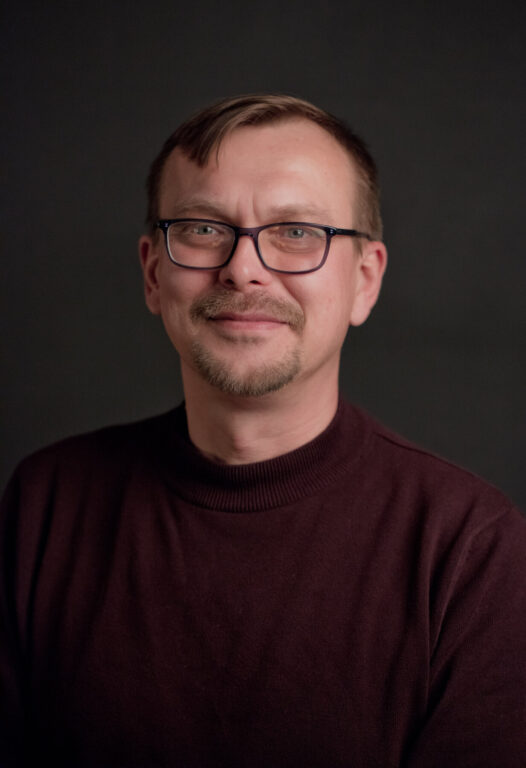
Chyla Julia M.

Julia Chyla digital archaeology

Julia Chyla digital archaeology

Julia M. Chyla, PhD

Department of Archaeology of the Americas

Non-Invasive and Digital Archaeology Laboratory

e-mail:
j.chyla@uw.edu.pl


Consultation hours:
Tuesday 11.30-13.15, room 3.23
Meeting can be held remotely, through the Google Meets platform.

Please apply in advance by email.

Dr Julia Maria Chyla is an Assistant Professor at the Faculty of Archaeology, University of Warsaw, Head of the Laboratory of Non-Invasive and Digital Archaeology (PANiC) and Faculty Coordinator for the DARIAH-PL Digital Research Infrastructure Project.

She specializes in digital archaeology, GIS, mobileGIS, remote sensing, photogrammetry, and non-invasive methods applied in archaeological prospection and landscape analysis. Her research focuses on the use of digital tools for documentation, spatial modeling, and heritage protection, with fieldwork experience in Peru (Castillo de Huarmey), Egypt, and Tunisia.

Dr. Chyla leads and participates in numerous national and international research projects funded by NCN, DLR, and DARIAH, including studies on pre-Columbian road networks and mobile GIS workflows.

She is a co-founder of Computer Applications in Archaeology Poland and the Mobile GIS Special Interest Group, and since 2021 has served as Editor-in-Chief of Archeowieści.pl, a nationwide popular science platform on archaeology.

Her work bridges research, teaching, and science communication, promoting open science and the integration of FAIR-compliant digital methods in archaeological research.


FAQ

When are office hours?

Tuesday 11:30–13:15 (room 3.23). Online meetings (Google Meet) available upon prior e-mail request.

Primary research area?

Digital archaeology: GIS, mobile GIS, remote sensing, photogrammetry; projects in Peru (Castillo de Huarmey), Egypt, Tunisia.

Specialisations and keywords

  • Digital archaeology, archaeological informatics
  • Archaeological GIS, remote sensing, photogrammetry
  • Least-Cost Path (LCP), least-cost corridors (LCC), agent-based modelling (ABM)
  • Mobile GIS, non-invasive documentation, FAIR data
  • Regions: Peru (Huarmey), Egypt, Tunisia

Roles and affiliations

Selected publications and open data

Flexible Borders, Permeable Territories and the Role of Water Management in Territorial Dynamics in Pre-Hispanic and Early Hispanic Peru

Patrycja Prządka-Giersz, Miłosz Giersz, Julia M. Chyla (2023/2024), in Living with Nature, Cherishing Language, eds. J. Olko, C. Radding, Palgrave Macmillan (Cham).
Overview of territorial dynamics on the northern Peruvian coast with emphasis on Culebras and Huarmey; water as a landscape factor; insights from Castillo de Huarmey (Wari).
DOI: 10.1007/978-3-031-38739-5_2


Offerings for Wari Ancestors: Strategies of ceramic production and distribution at Castillo de Huarmey, Peru

I. C. Druc, M. Giersz, M. Kałaska, R. Siuda, M. Syczewski, R. Pimentel Nita, J. M. Chyla, K. Makowski (2020),
Journal of Archaeological Science: Reports, 30, 102229.
Ceramic production and distribution around Castillo de Huarmey; evidence for local workshops (Huarmey/Culebras) and supply chains.
DOI: 10.1016/j.jasrep.2020.102229


Application of electron microprobe analysis to identify the origin of ancient pottery production from the Castillo de Huarmey, Peru

M. Kałaska, I. C. Druc, J. M. Chyla, R. Pimentel, M. Syczewski, R. Siuda, K. Makowski, M. Giersz (2020),
Archaeometry, 62(6), 1095–1114.
EMPA used to source Castillo de Huarmey pottery; complements petrography and identifies production areas.
DOI: 10.1111/arcm.12581


Deciphering the origin of small metal artefacts from Castillo de Huarmey (Peru) with Pb, Cu, and Ag isotopes

M. Kałaska, R. Mathur, G. D. Kamenov, J. M. Chyla, P. Prządka-Giersz, M. Giersz (2022),
Archaeometry, 64, 1168–1186.
Pb–Cu–Ag isotopes for elite Wari metal artefacts; raw-material sources and supply networks.
DOI: 10.1111/arcm.12775


The Dataset of the Geographical Dispersal of Islamic Cream Ware in Southern Bilad al-Sham (8th–11th Centuries)

Piotr Makowski; Julia M. Chyla (2024), Journal of Open Archaeology Data, 12, Article 4.
Data paper presenting 125 ICW sites and field structure; reuse potential for comparative analyses.
DOI: 10.5334/joad.122 ·
Linked dataset: UW Dataverse (ICW)


Geographical dispersal of Islamic Cream Ware (8th–11th c.) — spatial data

Repository with CSV/SHP, source bibliography and attribute descriptions for ICW distribution analyses.
Repository: UW Dataverse
DOI: 10.58132/Z8LR8I · License: CC BY 4.0


How Can Remote Sensing Help in Detecting the Threats to Archaeological Sites in Upper Egypt?

Julia M. Chyla (2017), Geosciences, 7(4), 97 (OA).
Case study of threats to sites in Upper Egypt using satellite imagery (urban and agricultural pressure; heritage protection implications).
DOI: 10.3390/geosciences7040097 ·
Full text: mdpi.com/2076-3263/7/4/97


The Northern Necropolis of Gebelein in Light of Old and Current Fieldwork

W. Ejsmond; A. Skalec; J. M. Chyla (2020), Journal of Egyptian Archaeology, 106(1–2), 105–122.
Reconstruction of the northern necropolis topography using archival records and recent fieldwork.
DOI: 10.1177/0307513320970944


Mobile GIS application on smartphones in archaeological field prospection

Julia M. Chyla (2019), in Forum GIS UW. GIS at the University of Warsaw. Proceedings of the 5th & 6th Forum GIS at UW, eds. J. M. Chyla, J. Lechnio, M. Stępień, D. Zaszewski, pp. 19–33.
Publishers: UW Faculty of Geology; UW Faculty of Geography & Regional Studies; Institute of Archaeology (Faculty of History), University of Warsaw. ISBN: 978-83-955918-0-8.
Smartphone-based Mobile GIS (Collector, Survey123) for archaeological field survey; Huarmey Valley (Peru) test case.
PDF/info: ResearchGate ·
full volume (PDF)


Mobile GIS in Archaeology: Current Possibilities, Future Needs. Position Paper

Julia Maria Chyla; Nazarij Buławka (2020), CAA proceedings (open access, Tübingen).
State-of-the-art and requirements for Mobile GIS in archaeology (hardware, GNSS, field workflows, data standards); summary of the CAA 2017 session.
DOI: 10.15496/publikation-43226 ·
Repository: TOBIAS-lib (University of Tübingen)


MobileGIS in archaeological prospection in Tunisia (Mustis) — data & workflow

Materials (attribute schemas, exports, sample maps/reports) supporting the standardisation of Mobile GIS.
Repository: Zenodo
DOI: 10.5281/zenodo.12601441

Academic profiles

ORCID: 0000-0002-9855-5332 ·
Google Scholar: profile ·
ResearchGate: profile ·
LinkedIn: profile ·
X/Twitter: @chyla_julia

Plavinski Mikalai 

dr Plavinski Mikalai
Dr. Mikalai Plavinski
Department of Medieval and Early Modern Archeology

e-mail:
m.plavinski@uw.edu.pl

 phone number:
+48 22 55 22 821 

duty hours:
Wednesday 12.00–14.00, room nr 3.21
Thursday 12.00–14.00, room nr 3.21

research interests:
The main area of research is the archeology of the Polack land, the study of the Slavic burial rite of the early Middle Ages, the history of medieval Eastern European weapons.

selected bibilography:
Mikalai_Plavinski.pdf

Lemke Martin

Martin Lemke
Martin Lemke, PhD
Department of Barbaricum and Roman Provincial Archaeology

e-mail:
m.lemke@uw.edu.pl

telephone:
+48 22 55 22 809

consultation hours:
Monday 11 a.m.–1 p.m., room 3.09
Tuesday 1 p.m–3 p.m., room 3.09

research interests:
– Limes archaeology
– Roman provinces in the Balkans
– Roman army logistics
– Roman aqueducts and methods of water supply
– Ancient and modern military geography

about me:
Graduate of the then Institute of Archaeology at UW and the Faculty of Management at UW. Defended my PhD in 2012 at the Faculty of History, University of Warsaw, with a dissertation on the Military Geography of Lower Moesia. Completed postgraduate studies in International Law.

From 2002 to 2022 employee of the Antiquity of Southeastern Europe Research Centre, University of Warsaw, among other things, coordinator of doctoral studies and project manager of the Danube Limes project under the EU’s Central Europe programme and the Frontiers of the Roman Empire project under the EU’s Culture 2000 programme.

Co-director of the project Archaeology of the Limes Maritimus Scythicus (formerly The Danube Underwater Heritage) and therein manager of the grant The Danube Underwater Heritage. Non-invasive underwater research along the Black Sea coast in the Danube Delta area, NCN: 2018/02/X/HS3/01745.
Author and promoter of Limes topics on behalf of the Limes Congress (e.g. S. Jilek, P. Dyczek, M. Lemke (eds.), In the Footsteps of the Romans, Warsaw 2011; S. Jilek, M. Lemke, P. Dyczek, J. Reclaw (eds.), The Danube Limes – A Roman River Frontier, Wien 2009). Member of the organising team of the 26th Limes Congress Batumi 2024.
Member of the Committee on the Archaeology of the Mediterranean Countries of the Polish Academy of Arts and Sciences and the Sports Council of the University of Warsaw.

bibliography:
ORCID
Academia.edu

selected publications:

  1. Lemke, The Dwindling Legion. Architectural and Administrational Changes in Novae (Moesia inferior) on the Verge to Late Antiquity, [in:] R. Collins, M. Weber, M. Symonds (eds.), Roman Military Architecture on the Frontiers in Late Antiquity: Armies and their Architecture, London 2015, 90-97.
  2. Lemke, Die Tücken des Terrains. Einige Aspekte der Militärgeschichte der Unteren Donau zwischen Limes und Neuzeit, [in:] G. Sommer von Bülow (ed.), Kontaktzone Balkan. Beiträge des Internationalen Kolloquiums “Die Donau-Balkan-Region als Kontaktzone zwischen Ost-West und Nord-Süd” vom 16. bis 18. Mai 2012 in Frankfurt am Main, Kolloquien zur Vor- und Frühgeschichte 20, Bonn 2015, 129-140.
  3. Lemke, Towards a military geography of Moesia inferior, [in:] L. Vagalinski, N. Sharankov (eds.), Limes XXII. Proceedings of the XXIInd International Congress of Roman Frontier Studies held in Ruse, Bulgaria (September 2012). Sofia 2015, 845-852.
  4. Lemke, Marsigli’s Moesia: the Limes Sites in Bulgaria as seen in the 18th Century, [in:] A. Tomas (ed.), Ad fines imperii Romani. Studia Thaddaeo Sarnowski septuagenario ab amicis, collegis discipulisque dedicate, Warszawa 2015, 173-192
  5. Lemke, A. Tomas, The Mithraeum at Novae revisited, [in:] A. Tomas (ed.), Ad fines imperii Romani. Studia Thaddaeo Sarnowski septuagenario ab amicis, collegis discipulisque dedicate, Warszawa 2015, 227-247.
  6. Lemke, Danube, Limes & Logistics. Some thoughts on Roman army supply chains in Moesia inferior, Novensia 27 (2016), 9-38
  7. Lemke, Zwei bronzene Acheloosmasken aus der hellenistischen Hafensiedlung Rhizon (Montenegro), Archäologisches Korrespondenzblatt 47 (4/2017), 489-500.
  8. Lemke, The water supply of the legionary fortress Novae (Bulgaria), [in:] S. Matešić, C.S. Sommer (eds.) Limes XXIII: Proceedings of the 23rd International Limes Congress Ingolstadt 2015. Akten des 23. Internationalen Limeskongresses in Ingolstadt 2015, 1015-1023, 2018
  9. Lemke, Advocatus diaboli – What if it was not the Eighth Legion that built Novae?, [in:] Novensia 29 (2018), 73-86.
  10. Lemke, G. Nuţu, M. Bajtler, K. Trusz, The Danube Underwater Heritage Project — First Steps, Novensia 29 (2018), 87-101.
  11. Lemke, M. Bajtler, K. Trusz, Naval Supply Lines for the Roman Army in Moesia Inferior — Basic Considerations for the Danube Underwater Heritage Project, [in:] „Światowit” Supplement Series U: Underwater Archaeology, vol. II (2019) – Archaeology: Just Add Water, 39-58.
  12. Lemke, S. Shpuza, B. Wojciechowski, Bushat, not lost but found: A ‘new’ Illyrian settlement in northern Albania, Antiquity 95/380, 1-9. doi:10.15184/aqy.2021.11
  13. Lemke, Wasserversorgung mit einem Hauch von Selbstdarstellung. Zu den gestempelten flavischen Tonrohren aus Novae, [in:] K. Balbuza, M. Duch, Z. Kaczmarek, K. Królczyk, A. Tatarkiewicz (eds.) Antiquitas Aeterna. Classical Studies dedicated to Leszek Mrozewicz on his 70th Birthday (= Phillippika 153), Harrassowitz Wiesbaden, 2021, pp. 185-197.
  14. Lemke, Lots of plumbing, little plumbum. The lead piping in Novae revisited on the occasion of a new find from sector 12, Novensia 30, 21-30.
  15. Lemke, M. Daszkiewicz, Mixing it up. An analysis of hydraulic mortars used in the conduits and sewage canals of the Roman legionary fortress Novae (Bulgaria): composition and context, forthcoming


Berto Claudio

Claudio Berto
dr hab. Claudio Berto, prof. ucz.
Katedra Archeologii Epoki Kamienia
Laboratorium Archeologicznych Analiz Specjalistycznych

e-mail:
c.berto@uw.edu.pl

phone number:
+48 22 55 22 842

duty hours:
Thursday 11.30–13.30, room 2.15

research interests:
– Microvertebrate Paleontology
– Biochronology
–  Quaternary Mammals
– Pleistocene palaeoecology
– Paleoclimate reconstructions
– Environmental reconstructions in Palaeolithic sites

bibliography:

Publications in indexed scientific journals

Berto C., Szymanek M., Blain H.-A., Pereswiet-Soltan, A., Krajcarz, M., Kot, M., 2021. Small vertebrate and mollusc community response to the latest Pleistocene-Holocene environment and climate changes in the Kraków-Częstochowa Upland (Poland, Central Europe). Quaternary International. https://doi.org/10.1016/j.quaint.2021.09.010

Kot, M., Gryczewska, N., Szymanek, M., Moskal del-Hoyo, M., Szeliga, M., Berto, C., Wojenka, M., Krajcarz, M., Krajcarz, M.T., Wertz, K., Fedorowicz, S., Jaskulska, E., Pilcicka-Ciura, H., 2021. Bramka Rockshelter: An Early Mesolithic cave site in Polish Jura. Quaternary International. https://doi.org/10.1016/j.quaint.2021.08.015

Berto, C., Krajcarz, M.T., Moskal-del Hoyo, M., Komar, M., Sinet-Mathiot, V., Zarzecka-Szubińska, K., Krajcarz, M., Szymanek, M., Wertz, K., Marciszak, A., Mętrak, M., Suska-Malawska, M., Wilcke, A., Kot, M., 2021. Environment changes during Middle to Upper Palaeolithic transition in southern Poland (Central Europe). A multiproxy approach for the MIS 3 sequence of Koziarnia Cave (Kraków-Częstochowa Upland). [accepted manuscript]. J. Archaeol. Sci. Reports 35. https://doi.org/10.1016/j.jasrep.2020.102723

López-García, J.M., Cuenca-Bescós, G., Galindo-Pellicena, M.Á., Luzi, E., Berto, C., Lebreton, L., Desclaux, E., 2021. Rodents as indicators of the climatic conditions during the Middle Pleistocene in the southwestern Mediterranean region: implications for the environment in which hominins lived. J. Hum. Evol. 150, 102911. https://doi.org/10.1016/j.jhevol.2020.102911

Berto, C., Nadachowski, A., Pereswiet-Soltan, A., Lemanik, A., Kot, M. , 2020. The Middle Pleistocene small mammals from the lower layers of Tunel Wielki Cave (Kraków-Częstochowa Upland): An Early Toringian assemblage in Poland. Quaternary International, in press. https://doi.org/10.1016/j.quaint.2020.10.023

Moncel, M.H., Santagata, C., Pereira, A., Nomade, S., Voinchet, P., Bahain, J.J., Daujeard, C., Curci, A., Lemorini, C., Hardy, B., Eramo, G., Berto, C., Raynal, J.P., Arzarello, M., Mecozzi, B., Iannucci, A., Sardella, R., 2020. The origin of early Acheulean expansion in Europe 700 ka ago : new findings at Notarchirico ( Italy ). Sci. Rep. 1–16. https://doi.org/10.1038/s41598-020-68617-8

Baca, M., Popović, D., Baca, K., Lemanik, A., Doan, K., Horáček, I., López-García, J.M., Bañuls-Cardona, S., Pazonyi, P., Desclaux, E., Crégut-Bonnoure, E., Berto, C., Lenardić, J.M., Miękina, B., Murelaga, X., Cuenca-Bescós, G., Krajcarz, M., Marković, Z., Petculescu, A., Wilczyński, J., Knul, M.V., Stewart, J.R., Nadachowski, A., 2020. Diverse responses of common vole (Microtus arvalis) populations to Late Glacial and Early Holocene climate changes – Evidence from ancient DNA. Quat. Sci. Rev. 233, 106239. https://doi.org/10.1016/j.quascirev.2020.106239

Berto, C., López-García, J.M., Luzi, E., 2019. Changes in the Late Pleistocene small-mammal distribution in the Italian Peninsula. Quat. Sci. Rev. 225, 106019. https://doi.org/10.1016/j.quascirev.2019.106019

Berto, C., Santaniello, F., Grimaldi, S., 2019. Palaeoenvironment and palaeoclimate in the western Liguria region (northwestern Italy) during the Last Glacial. The small mammal sequence of Riparo Mochi (Balzi Rossi, Ventimiglia). Comptes Rendus Palevol 18, 13–23. https://doi.org/10.1016/j.crpv.2018.04.007

Cheli Cheheb, R.C., Arzarello, M., Arnaud, J., Berto, C., Cáceres, I., Caracausi, S., Colopi, F., Daffara, S., Canini, G.M., Huguet, R., Karambatsou, T., Sala, B., Zambaldi, M., Berruti, G.L.F., 2019. Human behavior and Homo-mammal interactions at the first European peopling: new evidence from the Pirro Nord site (Apricena, Southern Italy). Sci. Nat. 106, 16. https://doi.org/10.1007/s00114-019-1610-4

Kot, M., Gryczewska, N., Berto, C., Wojenka, M., Szeliga, M., Jaskulska, E., Fetner, R., Krajcarz, M., Wertz, K., Zarzecka-Szubińska, K., Krajcarz, M.T., Moskal-del Hoyo, M., Leloch, M., Jakubczak, M., 2019. Thirteen cave sites: settlement patterns in Sąspów Valley, Polish Jura. Antiquity 93, e30. https://doi.org/10.15184/aqy.2019.155

López-García, J.M., Berto, C., Peresani, M., 2019. Environmental and climatic context of the hominin occurrence in northeastern Italy from the late Middle to Late Pleistocene inferred from small-mammal assemblages. Quat. Sci. Rev. 216, 18–33. https://doi.org/10.1016/j.quascirev.2019.05.025

Moroni, A., Boschian, G., Crezzini, J., Montanari-Canini, G., Marciani, G., Capecchi, G., Arrighi, S., Aureli, D., Berto, C., Freguglia, M., Araujo, A., Scaramucci, S., Hublin, J.J., Lauer, T., Benazzi, S., Parenti, F., Bonato, M., Ricci, S., Talamo, S., Segre, A.G., Boschin, F., Spagnolo, V., 2019. Late Neandertals in central Italy. High-resolution chronicles from Grotta dei Santi (Monte Argentario – Tuscany). Quat. Sci. Rev. 217, 130–151. https://doi.org/10.1016/j.quascirev.2018.11.021

Berto, C., Luzi, E., Canini, G.M., Guerreschi, A., Fontana, F., 2018. Climate and landscape in Italy during Late Epigravettian. The Late Glacial small mammal sequence of Riparo Tagliente (Stallavena di Grezzana, Verona, Italy). Quat. Sci. Rev. 184, 132–142. https://doi.org/10.1016/j.quascirev.2017.07.022

Boschin, F., Boscato, P., Berto, C., Crezzini, J., Ronchitelli, A., 2018. The palaeoecological meaning of macromammal remains from archaeological sites exemplified by the case study of Grotta Paglicci (Upper Palaeolithic, southern Italy). Quat. Res. 90, 470–482. https://doi.org/10.1017/qua.2018.59

Berto, C., Boscato, P., Boschin, F., Luzi, E., Ronchitelli, A., 2017. Paleoenvironmental and paleoclimatic context during the Upper Palaeolithic (late Upper Pleistocene) in the Italian Peninsula. The small mammal record from Grotta Paglicci (Rignano Garganico, Foggia, Southern Italy). Quat. Sci. Rev. 168, 30–41. https://doi.org/10.1016/j.quascirev.2017.05.004

Arnaud, J., Peretto, C., Panetta, D., Tripodi, M., Fontana, F., Arzarello, M., Thun Hohenstein, U., Berto, C., Sala, B., Oxilia, G., Salvadori, P.A., Benazzi, S., 2016. A reexamination of the Middle Paleolithic human remains from Riparo Tagliente, Italy. Quat. Int. 425, 437–444. https://doi.org/10.1016/j.quaint.2016.09.009

Berto, C., Bertè, D., Luzi, E., López-García, J.M., Pereswiet-Soltan, A., Arzarello, M., 2016. Small and large mammals from the Ciota Ciara cave (Borgosesia, Vercelli, Italy): An Isotope Stage 5 assemblage. Comptes Rendus Palevol 15, 669–680. https://doi.org/10.1016/j.crpv.2015.05.014

Blain, H.-A., Delfino, M., Berto, C., Arzarello, M., 2016. First record of Pelobates syriacus (Anura, Amphibia) in the early Pleistocene of Italy. Palaeobiodiversity and Palaeoenvironments 96, 111–124. https://doi.org/10.1007/s12549-015-0220-1

López-García, J.M.J.M., Luzi, E., Berto, C., Peretto, C., Arzarello, M., 2015. Chronological context of the first hominin occurrence in southern Europe: the Allophaiomys ruffoi (Arvicolinae, Rodentia, Mammalia) from Pirro 13 (Pirro Nord, Apulia, southwestern Italy). Quat. Sci. Rev. 107, 260–266. https://doi.org/10.1016/j.quascirev.2014.10.029

López-García, J.M., Berto, C., Luzi, E., Dalla Valle, C., Bañuls-Cardona, S., Sala, B., 2015. The genus Iberomys (Chaline, 1972) (Rodentia, Arvicolinae, Mammalia) in the Pleistocene of Italy. Ital. J. Geosci. 134, 162–169. https://doi.org/10.3301/IJG.2014.48

Peretto, C., Arnaud, J., Moggi-Cecchi, J., Nomade, S., Pereira, A., Falguères, C., Bahain, J.-J., Grimaud-Hervé, D., Berto, C., Sala, B., Lembo, G., Muttillo, B., Gallotti, R., Thun Hohenstein, U., Vaccaro, C., Coltorti, M., Arzarello, M., 2015. A Human Deciduous Tooth and New 40Ar / 39Ar Dating Results from the Middle Pleistocene Archaeological Site of Isernia La Pineta, Southern Italy. PLoS One 10, 1–19. https://doi.org/10.1371/journal.pone.0140091

López-García, J. M., Berto, C., Colamussi, V., Dalla Valle, C., Lo Vetro, D., Luzi, E., Malavasi, G., Martini, F., Sala, B., 2014. Palaeoenvironmental and palaeoclimatic reconstruction of the latest Pleistocene–Holocene sequence from Grotta del Romito (Calabria, southern Italy) using the small-mammal assemblages. Palaeogeography, Palaeoclimatology, Palaeoecology, 409, 169–179. https://doi.org/10.1016/j.palaeo.2014.05.017

Berto, C., Rubinato, G., 2013. The upper Pleistocene mammal record from Caverna degli Orsi (San Dorligo della Valle – Dolina, Trieste, Italy): A faunal complex between eastern and western Europe. Quat. Int. 284, 1–8. https://doi.org/10.1016/j.quaint.2011.07.025

Arzarello, M., Daffara, S., Berruti, G., Berruto, G., Berté, D., Berto, C., Gambari, F.M., Peretto, C., 2012. The Mousterian Settlement in the Ciota Ciara Cave: the oldest evidence of Homo neanderthalensis in Piedmont (Northern Italy). J. Biol. Res. – Boll. della Soc. Ital. di Biol. Sper. 85, 71–75. https://doi.org/10.4081/jbr.2012.4068

Publications in other scientific journals

Paronuzzi, P., Berto, C., Ghezzo, E., Hohenstein, U.T., Massarenti, A., Reggiani, P., 2018. Nota preliminare sulla sequenza UMG di ex Cava a Filo (Croara, BO): gli aspetti stratigrafico-sedimentari, paleontologici e antropici alla luce delle ultime indagini (2006-2016). Mem. dell’Istituto Ital. di Speleol. II, 131–144.

Berto, C., Luzi, E., Guerreschi, A., Fontana, F., Valletta, F., 2016. Small mammals from Mondeval de Sora (San Vito di Cadore, Belluno): paleoenvironmental differences between early and late Holocene. Preist. Alp. 48, 69–72.

Angelucci, D. E., Arnaud, J., Arzarello, M., Berruti, G. Berruto, G., Berté, D. Berto, C., Buccheri, F., Casini, A., Daffara, S., Luzi, E., López-García, J. M., 2015. Borgosesia, Monte Fenera. L’occupazione musteriana della grotta della Ciota Ciara, nuovi dati dalla campagna di scavo 2014. Quaderni Della Soprintendenza Archeologica Del Piemonte, 400-402.

Daffara, S., Arzarello, M., Berruti, G., Berruto, G., Bertè, D., Berto, C., Casini, A., 2014. The Mousterian lithic assemblage of the Ciota Ciara cave (Piedmont, Northern Italy): exploitation and conditioning of raw materials. Journal of Lithic Studies, 1, 2, 1-16. https://doi.org/10.2218/jls.v1i2.xxx

Arnaud, J., Arzarello, M., Berruti, G., Berruto, G., Bertè, D., Berto, C., Buccheri, F., Daffara, S., Luzi, E., López-García, J. M., Peretto, C., 2014. Borgosesia, Monte Fenera. Grotta della Ciota Ciara. Quaderni Della Soprintendenza Archeologica Del Piemonte, 29, 204–206.

Arzarello, M., Daffara, S., Berruti, G., Berruto, G., Bertè, D., Berto, C., Peretto, C., 2013. Borgosesia, Monte Fenera. L’occupazione musteriana della grotta della Ciota Ciara. Quaderni della Soprintendenza Archeologica del Piemonte, 27, 331-336.

List of published chapters in scientific monographs

Berto, C., 2020. I piccoli mammiferi (Strati N-F). In: Martini, F., Sarti, L. (Eds.), Il Musteriano Di Grotta Del Cavallo Nel Salento (Scavi 1986-2005). Culture e Ambienti. Museo e Istituto Fiorentino di Preistoria “Paolo Graziosi,” Firenze, pp. 75–83.

Sala, B., Berto, C., 2020. I grandi mammiferi (Strati F-N). In: Martini, F., Sarti, L. (Eds.), Il Musteriano Di Grotta Del Cavallo Nel Salento (Scavi 1986-2005). Culture e Ambienti. Museo e Istituto Fiorentino di Preistoria “Paolo Graziosi,” Firenze, pp. 65–74.

Berto, C., 2019. La microfauna, in: Steffè, G., Degasperi, N. (Eds.), Il Villaggio Neolitico Di Lugo Di Romagna Fornace Gattelli. Strutture, Ambiente, Culture. Istituto Italiano di Preistoria e Protostoria, Firenze, pp. 361–363.

Berto, C., Bon, M., Zampieri, S., 2012. I reperti faunistici provenienti dal sito del Neolitico recente di Botteghino (Parma), in: Atti Del 6° Convegno Nazionale Di Archeozoologia (Orecchiella, 2009). pp. 183–185.

Bon, M., Zampieri, S., Rocco, G., Berto, C., 2012. Analisi archeozoologica degli insediamenti tardomedievali e moderni di San Giacomo in Paludo (VE), in: Atti Del 6° Convegno Nazionale Di Archeozoologia (Orecchiella, 2009). pp. 351–354.


projects:

As Principal Investigator

2021-2025

OPUS20: 2020/39/B/HS3/00932. A palaeoecological approach to archaeological sites: The landscape of the human occupation between the late Middle Palaeolithic and Upper Palaeolithic in southern Poland

2021

Miniatura 4: 2020/04/X/ST10/01659. Environment and climate reconstruction in Central Italy between Late Pleistocene and early Holocene. Testing direct radiometric dating method on the small mammal bones from Grotta della Ferrovia

2020

IDUB: 501-D115-20-0004316. Climate and environment during the final Pleistocene to Early Holocene transition. Chronological framework of three archaeological cave sites in the Sąspów Valley

As Participant

2019-2021

Sonata BIS: 2016/22/E/HS3/00486. Settlement of the Sąspów Valley from Palaeolithic up to Modern times- elaboration of the unpublished fieldwork results of prof. Waldemar Chmielewski. Principal Investigator: Dr. Małgorzata Kot

2015 – today: From the Gravettian to the Epigravettian in Southern Italy. Changes in behaviour, technological know-how and symbolism at the cave sites of Paglicci (Rignano Garganico, Apulia) and La Cala (Camerota, Campania). Project founded by several Italian institutions such as MIUR (Italian Ministry for University and Research) and local communities. I am responsible for the small mammal collections study. Principal investigator: Dr. Adriana Moroni (University of Siena).

2015 – 2016 and 2019 – today: Early Evidence of Acheulean bifacial technology in Europe. Project founded by the Leakey Foundation. I am the responsible for the small mammal study of Notarchirico (Middle Pleistocene). Principal investigator: Prof. Marie-Hélène Moncel (MNHN – Paris).


Dzbyński Aleksander

Aleksander Dzbynski

dr hab. Aleksander Dzbyński
Department of Aegean and Textile Archaeology

e-mail:
a.dzbynski@uw.edu.pl

Phone number:
+48 22 55 22 814

Office hours: Mondays 15:00 – 16:00; Fridays 14:45 – 15:45 (by prior arrangement)

Research interests:
– development of mathematical cognition in prehistory
– philosophy
– archaeological theory
– history of science and technology
– archeoturism
– cognitive archaeology
– Paleolithic
– Neolithic
– Copper Age
– Bronze Age

Bibliography:
https://orcid.org/0000-0003-1739-4109